


Psalm Kolenda: Five Minutes to Cry—Why I Stopped Waiting for Athletes to Ask for Help
Updated: Sep 11
What an insane contradiction to my current situation: The sport that taught me to keep going would become the source of my greatest transformation. The same game that gave me dedication would leave me searching for preservation.
So, let me begin.
My older brother played fußball, and my cousins were already ingrained in the sport before I was ever a thought, before I understood the battles they fought or the lessons this game would teach: how close a dream could feel and still remain beyond your reach. My earliest memories are of sitting at fußball fields for hours, waiting for practices to finish, with a ball at my feet and my mother on the sideline, directing the players and riding every beat.

When you grow up in competitive sport, you learn the rules early: if you’re disappointed, you keep going; if you aren’t selected, you keep showing up; if you make a mistake, you correct it and work until they can no longer neglect it. You find a way into the starting lineup. You train harder, stand taller, and refuse to give up.
I learned that lesson before I was old enough to understand what it would cost: which parts of myself I would have to protect and which might eventually be lost.
Five Minutes to Cry
One vivid conversation has never left my mind. It happened in the car when my older brother was around 17, a memory frozen in place and time.
He was playing in a professional academy in Germany. He was one of the hardest-working people I had ever seen. They called him Maschine, the machine. He was the kind of person who would still be practicing his ball skills at three in the morning until my mother screamed
“Go to bed! This is insane!”
He had gone to boarding school at 12 years old to chase something bigger than himself, giving up early-morning training, school, team practices, tutoring, and late nights, only to wake up and do it all again.
Never stopping. Never complaining. No “I’m tired.” No “Why me?”
Yet some weeks, he would get only a few minutes on the field, if that. Imagine giving the game everything you have and receiving almost nothing back.
I remember one night after training when my mother was driving us home. My brother was curled up in the back seat, silent and alone.
I was sitting in the front, which was rare. In our household, the oldest always sat in the front, and the youngest sat in the back. But that night, he gave up what seemed to me to be his rightful place. Without a word. Without a fight. With defeat written across his face. He gave it up so easily that I was shocked. I knew something had to be wrong because the strongest person I knew suddenly didn’t seem strong.
As he lay curled up in the back seat crying, it was hard for me to see. This was my older brother, someone I admired, someone who had always seemed fearless to me.
He was the person who taught me to keep going, even when the pain was growing, even when no one was asking, and nobody seemed to notice what he was no longer showing.
The things he faced in boarding school from the age of 12 are not mine to explain. That is his story, his struggle, and his pain. But those experiences would have left many people speechless.

Still, whenever my mother asked, “Do you want to come home?” he always gave the same answer: “No, I want to stay. I want to keep going. I will find another way.”
But now, the same sport he had sacrificed so much for was killing him softly from the inside, breaking the person beneath the player while everyone focused on the performance outside. He was crying, and no one, not his coach, not anyone around him, ever asked what was happening inside his head.
It was driving him crazy.
That night in the car, my mother told him something that has stayed with me forever:
“You have five minutes to cry. Get it all out before we get home. Then dry your eyes. Tomorrow, you keep going. Tomorrow, you rise.”
Even saying those words now sends shivers through my body because my brother was truly, truly broken. His pain was visible. His feelings remained unspoken.
But “life is not fair” was one of my mother’s biggest sayings. She meant it as a lesson in resilience, something she had learned from surviving her own disappointments and still finding the strength to continue. Her rule for us was always the same: aim as high as possible, and never stop reaching.
The only way forward was to refuse to stay down: the moment you stopped fighting, somebody else was ready to take your place, your position, your chance. So no matter how deeply you were hurting, you wiped the tears from your face.
Looking back, I still believe there was something valuable in that lesson. But I have also come to understand something I couldn’t recognize as a kid: we talked about continuing. We never really talked about the pain itself. There was no time to explain that you felt unseen, or that the reality you were living no longer resembled the dream. No matter what you sacrificed or how hard you worked, the outcome remained the same. So you swallowed the pain, returned to the game, and kept moving forward while everything inside you stayed exactly the same.
As an athlete, five minutes can sometimes feel like all the time you get. The next roster is being selected. Somebody else is waiting for your position. So you learn to compress the stress and move on, because moving on is what everyone can see.
Years later, I would do almost exactly what my brother had done that night. Except I wouldn’t cry in the back of a car. I wouldn’t really tell anybody at all.
The Last Game I Played
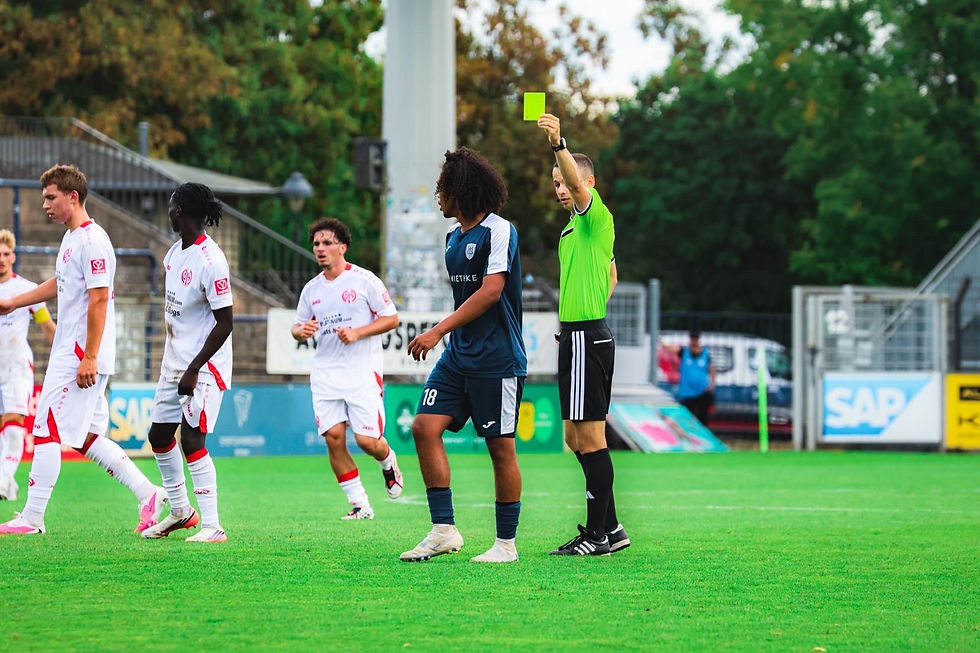
In August 2025, I was playing U19 fußball in Germany when I was selected to start against Wolfsburg. I remember the anxiety before the game because I knew how much that opportunity meant to me. We went down early, but as the game went on, I settled into it and found my rhythm.
Then halftime came. The coach substituted me.
There was no real conversation afterward. Nobody explained what I had done wrong, what I needed to improve, or how I could move forward. I didn’t know it then, but that would be the last match I played for that team. Not because anyone told me it was over. I was still there.
So I did what I had been taught my entire life to do: I worked harder. I went to training believing that if I showed enough, eventually I would earn another opportunity. I wasn’t selected. I trained harder. I wasn’t selected again. I kept believing commitment would lead to recognition, that dedication would eventually create another opportunity. But the harder I worked without communication, the more determination turned into isolation.
Months into it, the coach sent me a short message asking how I was doing. I told him I was working hard to get back onto the roster. He replied: “That’s what I like to hear.”
That was basically it. I Started to Feel Invisible
The part that affected me most wasn’t actually the lack of playing time. It was as though I had become invisible.
I was still there every day. I trained. I ran. I showed up on time.
But there was no meaningful feedback, no conversation about what I was doing well or badly, no sense that anyone was watching my development or helping me find a way back.
Being told directly that you aren’t good enough would hurt. But at least it would give you something:
A direction. An answer. Something specific to work on.
What I struggled with was not knowing. I kept thinking that if I trained harder, somebody would notice. But the longer nothing changed, the more I started questioning myself.
Maybe I’m not good enough. Maybe I have become so irrelevant that nobody thinks I’m worth an explanation.
That feeling followed me everywhere, into school, into bed at night.
Eventually, the problem wasn’t simply that I wasn’t playing fußball. The problem was that I was showing up every day to something I loved while slowly beginning to feel as though I no longer existed inside it.
“Yeah, I’m Okay.” From the outside, I probably looked completely fine. I went to school. I sat in class. I talked to my friends. I went to training. I smiled.
But fußball was almost all I thought about. I replayed that substitution repeatedly. I had trouble sleeping. I lost my appetite. Eventually, I started hating going to training.
That was the hardest part. fußball had given me happiness, identity, and purpose since I could remember. Now I dreaded it. Something I loved had become something I was forcing myself to survive every day.
But I kept showing up. Because that is what athletes do.
Here is the part that changed how I think about athlete mental health: I didn’t tell anybody how bad I felt. Not my family. Not my friends. Not my teammates. Part of it was pride. Part of it was believing I should be able to handle it. Part of it was not wanting the people who cared about me to worry about something they couldn’t immediately fix.
I had my faith. I prayed and talked to God every day, and that carried me through. I also knew I would eventually have an exit when the transfer window opened. That gave me something to hold on to when I felt like I was losing control.

But somewhere in those months, I started wondering: What about the athlete who doesn’t have an exit? What about the kid who doesn’t know how to put words to what they’re feeling, or doesn’t want their family to worry? What about the player who has become so good at “keeping going” that nobody realizes something is wrong?
Because that was exactly what I had done. I was miserable. But I was functioning. I think we sometimes confuse the two.
Even when the people around an athlete care enough to ask questions, the answer isn’t always honest. Sometimes an athlete hears, “Are you okay?” and immediately starts calculating the consequences of saying no.
Will I appear weak? Will this affect how the coach sees me? Will the person asking understand, or treat me differently?
So, “I’m okay” becomes the safest thing to say. That doesn’t mean parents, coaches, or teammates don’t care. Sometimes it means the athlete doesn’t know how to begin the conversation, or the person asking doesn’t know how to create enough safety for the truth to enter.
And these moments often aren’t completely invisible. A non-selection can be seen. So can an injury, a lost position, or being released. Nobody can automatically know what those events mean emotionally for an athlete. But people can recognize that something significant has happened.
What’s missing isn’t always information. It’s that nobody uses it as a reason to reach out.
What I Built From It
My own experience isn’t the only reason I began thinking about this. I watched my brother. I have played alongside hundreds of fußballers. I have seen players get injured, lose their positions, be removed from rosters, and be released.
Sometimes it happens slowly, sometimes in a single day: one moment you’re part of the team, the next, you’re not. Fußball keeps moving. The team trains tomorrow. But the person who just lost something they spent years working toward still has to go home and decide what happens next.
That is the question that eventually became GRADE, a project I began for a school assignment about athlete mental well-being and continued building afterward: what if we didn’t always wait for the athlete to ask for help?
GRADE is based on the idea that ordinary but significant events within an athlete’s environment could signal that it is time for a human being to reach out.
Repeated non-selection. Returning from an injury. Losing a starting position. Not playing in matches. Being released from a team.
These events don’t prove that an athlete is experiencing a mental-health crisis. The purpose isn’t to diagnose, judge, or assume something is wrong. The purpose is simply to notice.
For example, if an athlete is left off the roster three times, that visible event could prompt a trusted person, an actual human being, to reach out and begin a general conversation.
Not: “We think something is wrong with you.”
Just: “I noticed what happened. How are you doing?”
The athlete wouldn’t have to identify themselves as struggling, find the right person, create the right words, or raise their hand first. The event would open the door. A human being would walk through it.
Technology would recognize the situation, but a notification can’t replace empathy, and an app can’t replace humanity.
I’m 18 and still in my final year of high school. Building something doesn’t mean I have solved athlete mental health. I haven’t. My personal experience doesn’t prove this approach will work either. It gave me a question worth investigating, one I am trying to answer responsibly, with guidance from people who understand athlete well-being, safeguarding, psychology, and support far better than I do.
Because when pain remains unspoken, it can easily go unnoticed. And when an athlete never stops moving, everyone assumes they are still coping.
I Still Believe in “Keep Going”
I still believe in what my mother taught my brother in that car. There will be moments when life hurts, when somebody else receives the opportunity you wanted. Sometimes you have to dry your eyes, get up the next morning, and keep going. Fußball taught me that, and I am grateful it did. But I now believe there should be something else standing beside that lesson.
My brother has a saying now: “It can’t stay night forever. Eventually, day has to come.”
I used to think that was only about endurance, holding on through the night until you finally reached the light. Now I think it also means you shouldn’t have to wait out the night alone.
“Keep going” doesn’t have to mean “go through it alone.”
We should keep teaching athletes resilience and keep telling them it’s okay to ask for help. But maybe the responsibility cannot belong entirely to the athlete. Sometimes support begins because an athlete raises a hand and says, “I’m struggling.” And sometimes, maybe it should begin because somebody else notices what just happened and says: “I know you’re going to keep going. But before you do... how are you, really?”
For months, I did everything fußball had trained me to do. I showed up. I worked harder. I kept moving forward. And because I never stopped moving, almost everyone thought I was okay.
Years earlier, my brother had curled up in the back seat of our car, carrying pain that nobody within his fußball environment had stopped to understand. Years later, I carried my own pain differently: quietly, invisibly, without allowing anyone to see.
Two brothers. Two different moments. The same silent fight.
We both learned to keep going. Now I want to understand why we had to do it alone. That is the problem I want to understand. That is the silence I want to interrupt.
And that is why I started building GRADE.


